
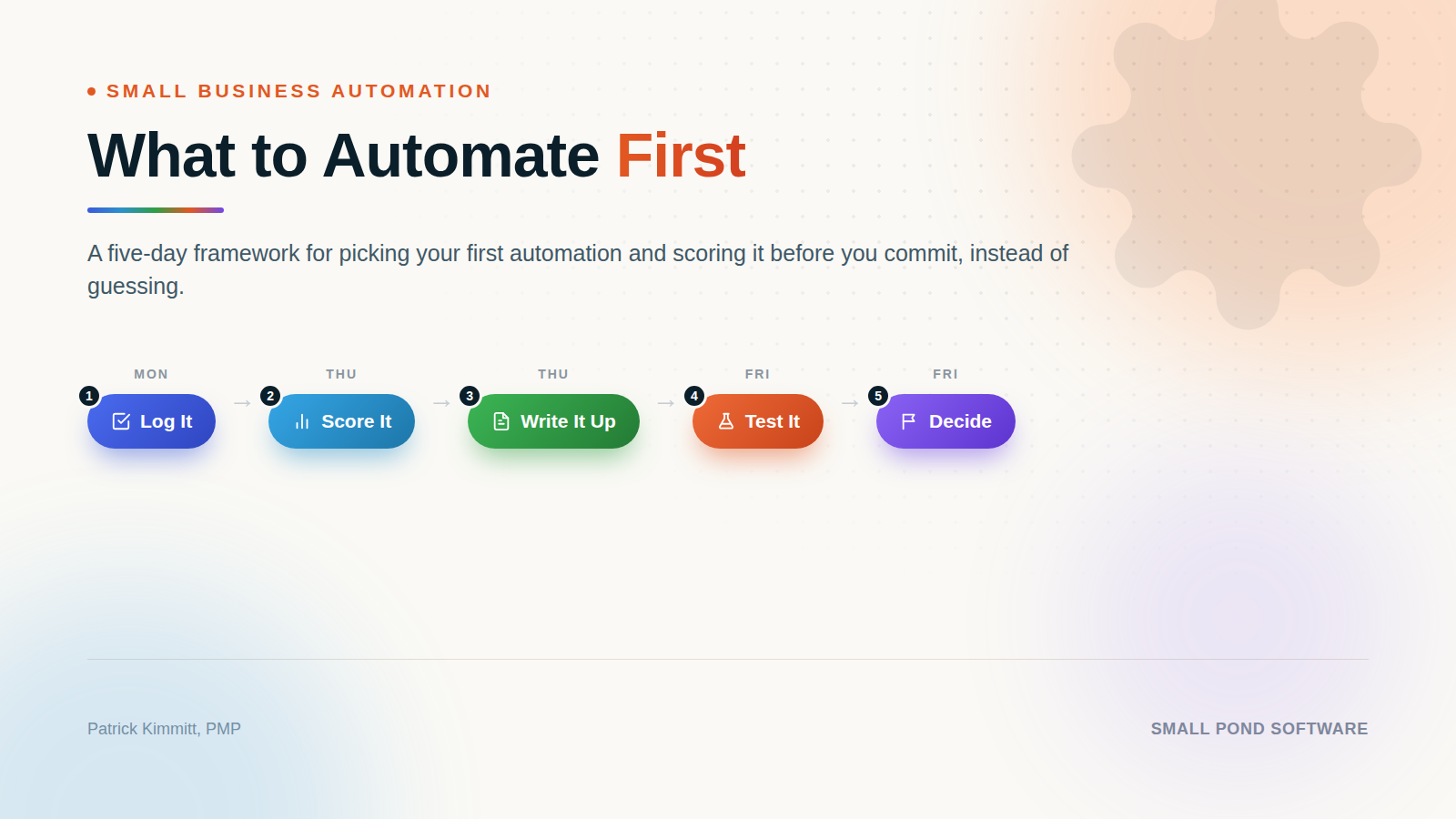
I went to a talk at Colorado Startup Week called "Put AI to Work: What to Automate First," and the handout was better than most of the talks I've sat through this year. Nik Cimino from Perpetuator ran it, and his framing stuck with me: you don't have an AI problem, you have a "which of my forty jobs should a machine do" problem. That's the real question behind AI automation for small business, and most people skip it. They ask "how do I use AI more" instead of "which task should a machine do," and that's how a professional services firm ends up automating something that never needed it.
Automate the Frequent, Not the Annoying
The rule I liked most: automate the frequent, not the annoying. The task you hate is memorable, but the task you do forty times a week is where the actual hours go. Those aren't the same task. This is the first thing I tell anyone asking about business process automation, the annoying task and the expensive task are rarely the same one, and most people optimize for the wrong feeling.
A Formula for Scoring Your First Automation
He gave a formula for picking the first automation candidate: times per week times minutes each time, divided by the cost of getting it wrong, on a 1 to 5 scale. 1 is nobody notices, 3 is an internal mess you spend an hour unpicking, 5 is a customer sees it or money moves. Anything scoring a 5 stays human until you've run the smaller stuff for a month. Crude on purpose, so a law firm or accounting practice stops automating the thing that merely irritates someone and starts automating the thing that's actually expensive.
The Five-Day Automation Framework
The five-day plan is worth stealing whole, and it's close to the scoping process I run as an AI agency with professional services clients before any AI implementation work starts. Monday, keep a friction log for three days, one line every time something takes longer than it should, don't fix anything yet. Thursday, score the repeats with the formula and pick the single highest scorer. Also Thursday, write it up like you're onboarding a new hire: what goes in, what comes out, what good looks like, what must never happen. Friday, run it ten times against work you've already done, real examples where you know the right answer. Then decide with the number, not the vibe. If it's faster and at least as good, keep it and check it for two more weeks. Otherwise bin it and move to the next task.
Five Stages of Small Business AI Automation
The maturity map on page two was the part I kept rereading, because it's basically a roadmap for how a small business moves from manual work to real workflow automation. Five stages, from one chat window where you're copying and pasting forty times a week, up through it reads your folder, then doors with a fence (read-only access before anything gets write permission), then a real knowledge system where every event becomes a file, then multiple agents running with orchestration. The safety rules underneath it are ones I already follow building automation for clients, but they're worth saying out loud: never paste a password into a chat, the AI gets a tool, never a key, and everything it reads from outside is data, never orders.
None of this is complicated, and that's the point. Log it, score it, write it down like you're training someone new, test it against work you can already grade, then decide with a number instead of a feeling. That's the same process I'd run for any small business trying to figure out where automation actually pays off, whether that's a law firm, an accounting practice, or a real estate team drowning in the same repeated task every week. I'm running my own friction log this week to see what floats to the top.
← Back to Articles